



Top Metal Manufacturing Companies for Global Buyers

Choosing a metal manufacturing partner can shape product quality, delivery schedules, and the cost of every revision. For global buyers, a polished website is not enough. The useful evidence lies deeper: alloy traceability, process controls, inspection records, and clear answers about production capacity. A mill certificate matters. So does a machinist who can explain how a tight tolerance will be held across a production run.

Manufacturing expert Shigeo Shingo observed, “The most dangerous kind of waste is the waste we do not recognize.” That warning applies to supplier selection. Hidden waste may appear as repeated rework, unclear specifications, or a shipment delayed by one missing document. This guide introduces leading metal manufacturing companies and the capabilities buyers should examine, from casting and forging to sheet-metal fabrication and precision machining. It also considers quality systems, communication, scalability, and the practical limits of published claims. Details vary by facility. Ask for evidence.

A shortlist is a starting point, not a verdict. Buyers should compare relevant certifications, sample inspection reports, material documentation, and recent experience with similar parts. Where possible, discuss tolerances using an actual drawing, not a broad promise. Small details count. A supplier may excel at prototypes yet struggle with repeat volume, or offer impressive equipment without the right finishing process. No ranking can capture every project’s needs. The strongest choice is the company that can show how its process fits yours—and admit where it does not.
Top Metal Manufacturing Companies for Global Buyers

Defining Metal Manufacturing and Its Global Market

Metal manufacturing turns ores, recycled scrap, and purchased alloys into usable parts and structures. Processes include melting and casting, rolling, forging, machining, welding, and surface finishing. A steel beam may begin as liquid metal, then pass through rollers before cutting and coating. Definitions are not perfectly tidy: some reports count primary production, while others include fabricated products and downstream services. Buyers should check the boundary before comparing market figures.

The scale is enormous, but it is not one market. The World Steel Association’s World Steel in Figures 2024 reports 1,892.2 million tonnes of crude steel production in 2023. The International Aluminium Institute reported about 70.6 million tonnes of primary aluminium that year. These figures describe different metals and production stages, not total manufacturing revenue. Still, they show why global buyers assess capacity, alloy consistency, energy exposure, lead times, and shipping together. A low quote can conceal long transit or extra finishing steps. Sometimes the weakest link is a small detail: tolerance records, for example. Trade data also misses variation in quality and delivery reliability, so statistics are a starting point, not a supplier verdict.

Key Criteria for Comparing Metal Manufacturing Companies

Choosing among metal manufacturing companies requires more than comparing quoted prices. Start with process fit: a supplier skilled in laser cutting may not be the best choice for deep drawing or precision machining. Ask which materials, thicknesses, and production volumes they handle regularly. Request sample inspection reports and confirm how they measure critical dimensions, such as hole spacing or sheet thickness. Clear evidence matters more than broad capability claims.

Tips: Send the same drawing and specification to each candidate. Ask about tolerances, inspection frequency, and what happens when a part fails inspection. Compare written answers, not just sales calls.

Check material traceability, production capacity, delivery estimates, and change-control practices. A reliable partner should explain how revisions are recorded and how delays are communicated. Review a sample part for edge quality, finish, and fit, then discuss any differences against the drawing. Compare total cost, including tooling, packaging, and freight, rather than the unit price alone. A polished capability sheet can still leave practical questions unanswered. I have found that small details, like who approves a drawing revision, can prevent expensive rework. But the lowest-risk option is not always the cheapest, and a trial order may reveal issues that references cannot.

Major Manufacturing Regions and Their Industry Strengths

Metal manufacturing clusters reflect decades of supplier investment, skilled labor, and transport access. China’s coastal regions offer broad capacity, from steel processing to fabricated components, often supported by dense supplier networks. Japan and South Korea are known for precision production and advanced process control. India’s growing industrial centers can offer expanding capacity, though supplier capabilities vary considerably.

Europe brings strong engineering expertise. Germany and Italy have established machinery, automotive, and specialty metal sectors, while Central European locations can connect production with regional supply chains. In North America, the United States and Mexico serve diverse industries, including construction, energy, and vehicle manufacturing. Port access, rail links, and proximity to customers can matter as much as hourly labor costs. A region’s reputation is not a quality guarantee. That distinction is easy to overlook.

Tips: Compare suppliers using the same material specifications, drawings, and inspection criteria. Ask for sample test reports and clarify how defects are handled. Check lead times against actual shipping routes, not just factory estimates. Visit when practical. Even strong regions have uneven suppliers, and that uncertainty deserves attention.

Top Metal Manufacturing Regions: Major Markets and Industry Strengths

2023 crude steel production in selected major manufacturing markets (million metric tons). Values represent individual markets, not regional totals.

East Asia combines large-scale integrated steelmaking with strong automotive, shipbuilding, and electronics supply chains. South Asia’s capacity is expanding alongside infrastructure and construction demand. North America is supported by advanced manufacturing and electric-arc-furnace production, while Europe and Eurasia retain strengths in engineering, specialty steels, and industrial supply. Figures are from the World Steel Association’s 2023 crude steel production data.

Core Products, Materials, and Production Capabilities

Global buyers should compare metal manufacturers by the products they make and the processes they control. Common offerings include sheet, plate, coil, structural sections, tubes, and precision-machined parts. Materials may range from carbon steel and stainless steel to aluminum and copper alloys. The right choice depends on the part’s load, environment, and required finish. Details matter.

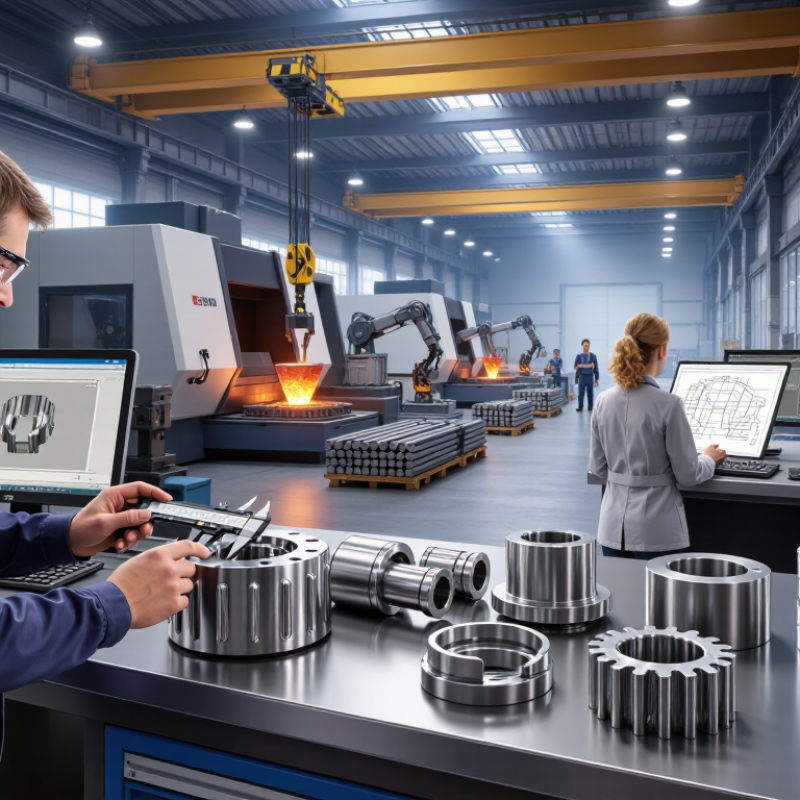
Production capability is more than a list of machines. Ask whether a facility can roll, cut, bend, weld, heat-treat, or coat the material in-house. A shop with laser cutters may handle intricate sheet profiles, while heavy plate work requires suitable press capacity and lifting equipment. Request sample inspection records, material certificates, and clear tolerance data. These documents help verify that specifications match the delivered product.

Capacity and consistency need equal attention. Confirm typical order sizes, tooling requirements, inspection steps, and realistic lead times before approving production. If a supplier reports tight tolerances, ask how often measurements are taken and what equipment is used. A sample part can reveal burrs, uneven finishes, or fit problems that a polished capability sheet may miss. That takes time. It is worth allowing for. No factory is perfect, and a clear account of limits is often more useful than a broad promise.

How Global Buyers Evaluate and Select Suppliers

Global buyers comparing metal manufacturers should verify process control, not just quoted price. Request recent inspection records, material test certificates, and traceability from heat number to finished part. A sample audit can reveal whether drawings, tolerances, and surface-finish requirements are understood consistently. A polished brochure proves little. Check machine capacity, calibration dates, nonconformance logs, and how corrective actions were closed. Ask for realistic lead times during peak demand, not only the best-case schedule.

Resilience also deserves a measurable place in supplier reviews. McKinsey Global Institute’s 2020 supply-chain analysis estimated that disruptions lasting a month or longer occur about every 3.7 years. It also estimated that such shocks could erase 45% of one year’s profits over a decade. Buyers can therefore compare backup production capacity, raw-material sourcing, inventory policies, and shipment performance. Request evidence, such as delivery records across several quarters, rather than relying on assurances. Total landed cost should include packaging, inspection, freight, and likely rework. Still, no scorecard captures every shop-floor surprise. A short technical call with the production team can expose gaps that a spreadsheet misses. One overlooked detail: confirm who approves drawing changes and how revisions reach operators.

Top Metal Manufacturing Companies for Global Buyers - How Global Buyers Evaluate and Select Suppliers

Evaluation Dimension What Buyers Should Verify Useful Evidence and Selection Checks Suggested Weight Common Risk Signal
Product and process capability Whether the supplier can make the required alloy, part geometry, production volume, and finish. Review process routes such as casting, forging, machining, sheet-metal forming, or welding. Compare documented equipment capacity and sample parts with the buyer’s drawings and specifications. 20% Capabilities are described broadly but are not supported by process details or relevant samples.
Quality management How the supplier controls inspection, nonconformities, corrective actions, and production changes. Check the scope and validity of its quality-management certification, internal inspection procedures, calibration records, inspection plans, and recent corrective-action examples. Certification scope should match the supplied product or process. 20% Certificates are expired, outside the relevant scope, or difficult to verify.
Material traceability Whether material grades and production batches can be traced through manufacturing and delivery. Request a sample material certificate and confirm that heat or batch numbers connect to the purchase order, production records, and finished goods. EN 10204 Type 3.1 is one commonly used inspection-document type for metallic products. 12% Material documents cannot be matched to the delivered batch or specified grade.
Inspection and testing Whether inspection methods are appropriate for the part’s function, risk, and drawing requirements. Confirm dimensional inspection, material testing, and any specified non-destructive testing. Agree acceptance criteria, sampling plans, inspection records, and responsibility for third-party inspection before production. 12% Inspection is offered without defined methods, acceptance criteria, or recorded results.
Welding and fabrication control For welded products, whether welding procedures and personnel qualifications meet the applicable project requirements. Review relevant welding procedure and welder qualification records, fabrication controls, and inspection requirements. Standards such as ISO 3834 or AWS D1.1 may apply depending on product, contract, and jurisdiction. 8% Welding credentials or inspection plans do not cover the required material, process, or application.
Delivery and capacity Whether the supplier can meet the required delivery schedule and sustain the expected order volume. Ask for a production plan, capacity assumptions, lead-time breakdown, and contingency arrangements for bottleneck operations or material shortages. Validate proposed timing against the buyer’s order quantity and approval requirements. 10% Delivery promises are not tied to capacity, material availability, or a documented schedule.
Regulatory and market access Whether the product and documentation meet the requirements of the destination market and intended use. Identify applicable product, safety, pressure-equipment, structural, and import requirements before placing an order. For example, the EU Pressure Equipment Directive or EN 1090 requirements may apply to certain products; applicability depends on the product and use. 6% Compliance claims are made without identifying the relevant product scope or supporting documents.
Total cost and commercial clarity Whether the quoted price reflects the complete order scope and commercial terms. Compare tooling, packaging, testing, freight, duties, payment terms, currency, Incoterms, and change-order conditions. Use the same specification and delivery basis when comparing quotations. 6% Important costs, exclusions, or delivery responsibilities are left undefined.
Communication and engineering support Whether technical questions, drawing revisions, and production issues are handled clearly and promptly. Evaluate the quality of quotation responses, drawing reviews, revision control, escalation contacts, and written approval records during a trial project. 3% Conflicting answers or uncontrolled drawing revisions create uncertainty about the order requirements.
Environmental and worker-safety practices Whether the supplier manages relevant environmental and occupational health and safety risks. Review applicable permits, risk controls, and management-system evidence. ISO 14001 and ISO 45001 are examples of voluntary management-system standards; certification alone does not replace legal compliance checks. 3% Relevant operational risks or compliance responsibilities are not clearly addressed.

Note: Suggested weights are a buyer-side scoring framework, not an industry-wide ranking. Adjust them to the product’s complexity, end use, order volume, and destination-market requirements. Technical tolerances, inspection levels, certifications, and delivery targets should be defined in the contract and product documents.