Top 10 Types of Scooter Motors for Buyers?
Choosing a scooter motor is not simply a matter of picking the highest power rating. The motor affects acceleration, hill climbing, noise, maintenance, and how efficiently a scooter uses its battery. Scooter Motors also differ in where they sit, how they transfer power, and how much care they may need over time. Some designs suit flat city streets, while others cope better with steep routes or heavier loads.
Some categories overlap. That matters. A hub motor, for example, describes its location, while brushed or brushless describes its operating design. Buyers can miss this distinction when product listings use broad labels. Rated power is useful, but it does not tell the whole story. Check the motor’s voltage, torque, controller compatibility, wheel size, and thermal limits. Consider your usual route, rider weight, desired range, and access to replacement parts.
This guide introduces ten common scooter motor types and explains what each may offer in everyday use. It also points out trade-offs, such as quieter operation versus repair complexity, or strong climbing ability versus greater battery demand. Manufacturer specifications are not always measured in the same way, so compare them carefully. Real performance can vary with load, temperature, tire pressure, and riding style. A detail that looks small on a spec sheet can matter on a long incline. And no single motor is best for everyone. The right choice depends on how and where you ride.
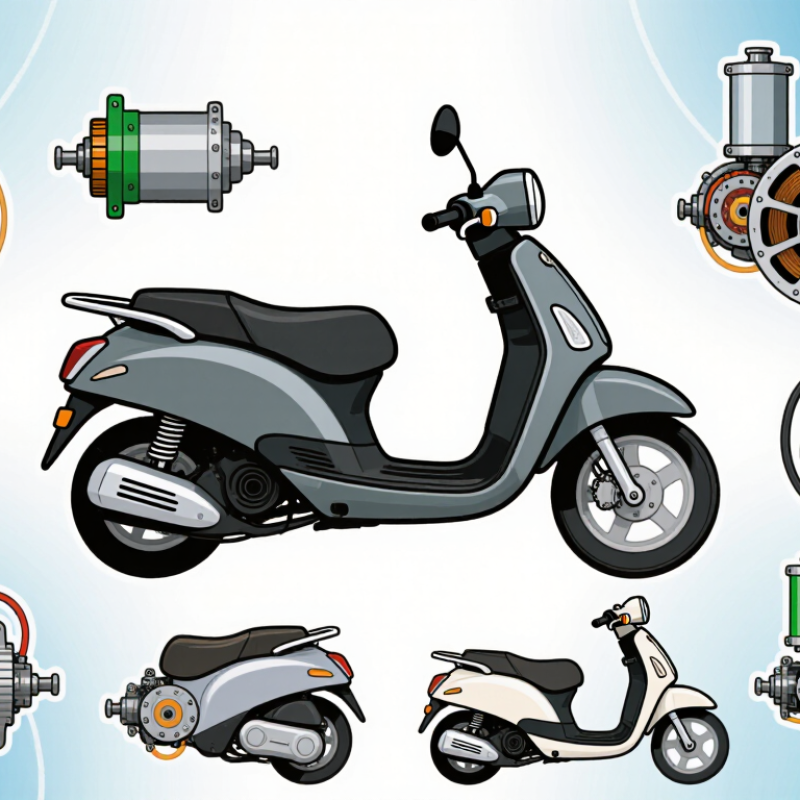
Classify Scooter Motors by Commutation: Brushed DC, BLDC, and PMSM
Top 10 Types of Scooter Motors for Buyers?
Scooter motors differ in how they switch electrical current through their windings. Brushed DC motors use physical brushes and a commutator. Their design is straightforward, but brushes wear and may need replacement. BLDC motors remove those contact parts. An electronic controller switches current between the windings, typically using rotor-position information. This reduces routine wear, though controller quality matters. PMSM motors also use permanent magnets, but generally rely on smoother, often sinusoidal current control. In practice, BLDC and PMSM labels can overlap across product descriptions.
Tips: Check the motor and controller specifications together. A quiet wheel motor is not enough; confirm voltage, rated power, cooling method, and replacement-part availability. Ask how the system behaves on steep climbs, where heat can build quickly.
For buyers, commutation type is only one part of the decision. A brushed motor may suit a simple, lower-cost repair setup, while brushless designs are common where reduced maintenance is preferred. PMSM control can offer smooth operation, but performance depends on the controller and tuning. I would not treat every seller’s terminology as perfectly standardized. Compare the technical data, not just the label, and look for clear limits on continuous power and temperature.
Compare Hub Designs: Geared, Direct-Drive, and In-Wheel Motors
A scooter motor’s label can hide important differences. Geared hub motors use internal reduction gears to increase wheel torque. They often feel lively when starting from a stop or climbing a short hill. Their gears add moving parts, though, and may wear over time. Listen for unusual clicking, and check whether replacement parts are available.
Direct-drive hub motors turn the wheel without reduction gears. Their simple layout can mean less routine mechanical wear, but the motor may be heavier. Some models also support regenerative braking, depending on the controller and battery. The effect is often modest. On a long ride, that extra weight may matter more than expected.
“In-wheel” describes where a motor sits, not one distinct motor design. Both geared and direct-drive hubs can be built into a wheel. Compare the actual mechanism, not just the label. Check motor wattage alongside wheel size, rider weight, and typical slopes; a high number alone does not guarantee strong hill performance. A test ride helps. Feel the launch, listen for gear noise, and notice how the scooter handles bumps. Specifications still leave gaps. That part is easy to overlook.
Assess Mid-Drive, Induction, Axial-Flux, and Radial-Flux Motor Types
Mid-drive describes motor placement, not a magnetic-flux design. It sits near the frame’s center and sends power through a chain or belt. This can improve weight balance and use gearing effectively on hills. But it adds moving parts, and maintenance matters. A neat category chart can mislead buyers here.
Induction motors create rotor current through a changing magnetic field, avoiding permanent magnets. They can be durable, though controller setup and heat management affect real-world efficiency.
Axial-flux motors use a flat, disc-like layout. Their compact shape can deliver strong torque for their size, but cooling and production complexity deserve a close look.
Radial-flux motors use a more familiar cylindrical layout, often making packaging and cooling easier.
The IEA’s Global EV Outlook 2024 estimates nearly 10 million electric two- and three-wheelers were sold worldwide in 2023. That scale makes efficiency, serviceability, and cost practical buying questions—not just engineering details.
Compare motors at the speeds and loads you actually ride. A steep, stop-start commute is different from steady travel on flat roads. Ask for rated and peak power, thermal limits, and efficiency data across operating speeds. Peak torque alone is a weak comparison. Some specifications are hard to compare directly; that is worth admitting.
Compare 24–72 V Systems by Rated Power (W), Peak Power (W), and Torque (N·m)
Buyers often compare scooter motors by voltage, but voltage alone cannot predict performance. A 24 V, 36 V, 48 V, 60 V, or 72 V system depends on controller current, motor design, and cooling. Compare rated power in watts for sustained use, then peak power for brief acceleration. Peak output is not a continuous rating. Numbers need context.
Common buyer categories include brushed hub, brushless hub, geared hub, direct-drive hub, mid-drive, chain-drive, belt-drive, single-motor, dual-motor, and axial- or radial-flux designs. These labels can overlap because they describe different design features. Compare torque in N·m, too, and check where it was measured. Motor-shaft torque differs from wheel torque; gearing and wheel diameter affect force at the road. A large torque figure can still mislead.
Tips: Compare test results at similar battery charge and load. Ask for rated watts, peak watts, torque, and measurement conditions. A short hill climb can reveal cooling limits. I would not choose by peak power alone; that shortcut is tempting, and sometimes wrong.
Top 10 Types of Scooter Motors for Buyers? - Compare 24–72 V Systems by Rated Power (W), Peak Power (W), and Torque (N·m) | Motor type | Typical system voltage | Rated power (W) | Peak power (W) | Indicative torque (N·m) | Buyer notes |
| Brushed DC motor | 24–48 V | 250–500 | 500–1,000 | 8–20 | Simple control and low initial cost; brushes wear and require maintenance. |
| Geared BLDC hub motor | 24–60 V | 250–1,000 | 500–2,000 | 25–80 | Reduction gearing boosts wheel torque and hill-start ability; gears can wear over time. |
| Direct-drive BLDC hub motor | 36–72 V | 500–1,500 | 1,000–3,000 | 20–60 | Few moving parts and low routine maintenance; typically heavier than geared hubs. |
| BLDC mid-drive motor | 36–72 V | 500–1,500 | 1,000–3,000 | 40–120 | Uses reduction gearing to deliver strong drive torque; drivetrain complexity and maintenance are higher. |
| Permanent-magnet synchronous motor (PMSM) | 48–72 V | 500–2,000 | 1,000–4,000 | 30–100 | Smooth, efficient operation with electronic control; performance depends on the controller and cooling. |
| Axial-flux motor | 48–72 V | 500–2,000 | 1,000–4,000 | 25–90 | Flat, compact construction can provide high torque for its size; availability and thermal design vary. |
| Outrunner BLDC motor | 36–72 V | 500–2,000 | 1,000–4,000 | 20–80 | Outer rotor can produce useful torque at lower speed; check mounting, protection, and cooling. |
| Inrunner BLDC motor | 36–72 V | 500–1,500 | 1,000–3,000 | 5–25 | Compact, high-speed rotor; often paired with reduction gearing when more wheel torque is needed. |
| Induction motor | 48–72 V | 500–1,500 | 1,000–3,000 | 10–40 | Does not rely on permanent magnets; controller requirements and efficiency at light loads need consideration. |
| Switched-reluctance motor | 48–72 V | 500–1,500 | 1,000–3,000 | 10–40 | Robust rotor construction; torque ripple, noise, and specialized control can affect ride comfort. |
| How to read these figures: Ranges are representative estimates for scooter-scale systems, not standardized specifications. Actual ratings depend on motor size, controller current, cooling, wheel size, gearing, and duty cycle. Peak power is typically available only for short periods. Torque figures are indicative at the motor output or geared output; hub-motor torque is at the wheel. Compare manufacturer test conditions before purchase. |
Check BLDC Efficiency Claims of 85–90% Against Test Conditions and Heat Limits
A BLDC scooter motor advertised at 85–90% efficiency may reach that figure only under specific test conditions. Ask whether the measurement covers the motor alone or the complete drive system, including the controller. A bench test at steady speed and moderate load can look very different from a steep climb with a rider, cargo, and repeated stops. Numbers need context.
Check the test voltage, wheel speed, torque, ambient temperature, and measurement method. Efficiency changes across the motor’s operating range; one peak figure cannot describe every ride. Heat matters. During a long hill climb, winding temperature can rise, increasing resistance and reducing output. A motor may also be limited by its controller or thermal protection before the advertised peak power can continue.
Look for continuous ratings and the conditions behind them, not just a brief maximum. If a seller provides no test details, treat the percentage as a starting point, not a guarantee. Compare similar motors under similar loads, and consider how quickly each can shed heat. Even careful specifications leave some uncertainty: real routes, tire pressure, and rider weight vary, sometimes more than expected.
Top 10 Scooter Motor Types: Indicative Peak Efficiency Ranges
Approximate motor or motor-drive peak-efficiency ranges. These are indicative, not standardized head-to-head test results.
How to read this: BLDC claims of 85–90% can be plausible near a motor’s efficient operating point, but are not guaranteed across riding conditions. Comparisons depend on test speed, torque, voltage, winding temperature, controller losses, and whether efficiency is measured at the motor or battery-to-wheel level. Heat limits and sustained load can reduce real-world efficiency.