




Top 10 Empty Eyeshadow Palette Manufacturers Worldwide
Choosing an Empty Eyeshadow Palette manufacturer can shape a beauty brand’s product quality, launch schedule, and packaging costs. An empty case may look simple, yet its hinge, pan fit, mirror, surface finish, and closure all affect daily use. Small details matter. Loose pans can shift in transit, while a lid that closes poorly may frustrate customers. Supplier selection deserves more than a polished catalog.
This guide introduces ten manufacturers for buyers to research and compare. “Top” is not a universal verdict; the right choice depends on your product brief, budget, and order volume. Review material options, color matching, decoration methods, minimum order quantities, sample availability, production timelines, and documented quality checks. Request current specifications and inspect a pre-production sample whenever possible. Confirm whether quoted prices include inserts, mirrors, printing, and protective cartons. Details can change. Suppliers may also vary by factory, region, and project.
Some projects call for compact travel cases; others need larger pans, custom finishes, or space for a mirror and applicator. When comparing manufacturers, consider how each handles design revisions, communication, and repeat orders—not just the first sample. Ask for evidence behind quality or sustainability claims, and clarify which production details apply to your specific order. A glossy finish in a photograph cannot reveal how a case feels in hand. Use the profiles as a starting point, then verify practical details directly. Even a promising shortlist may need revision after testing.
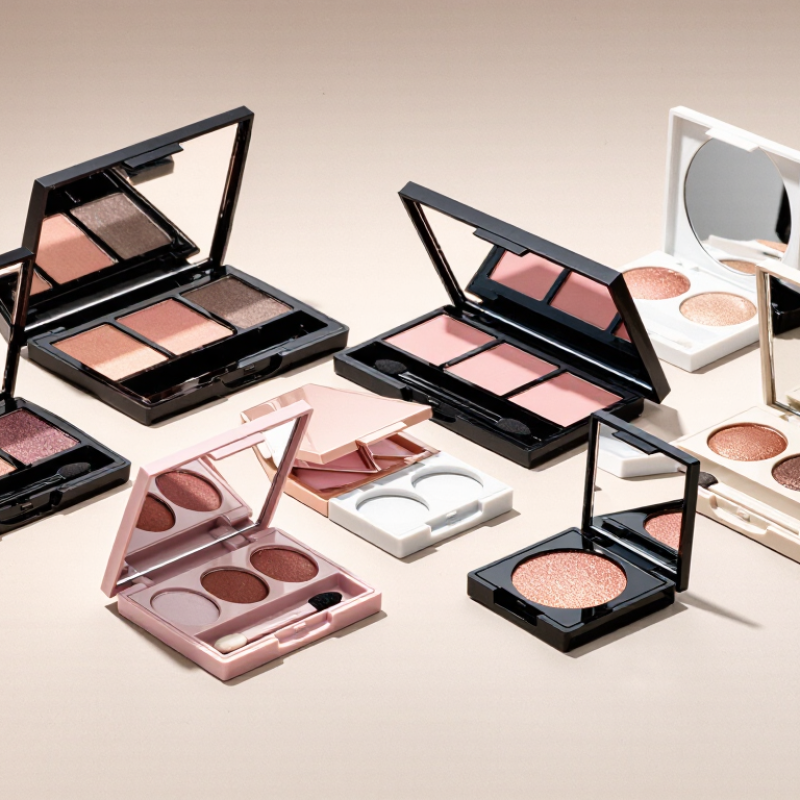
Empty Eyeshadow Palettes: Formats, Materials, and Pan-Fit Specifications
Empty eyeshadow palettes come in single-pan, quad, and larger multi-pan formats. Hinged compacts suit daily use, while removable trays make shade changes easier. Travel styles benefit from secure closures and corners that resist cracking. Small details matter.
Common shells use ABS or polypropylene plastic; paperboard offers a lighter, less rigid alternative. Clear lids help users identify shades, but they can show scratches and fingerprints. Metal pans may sit in molded wells, attach with magnets, or use adhesive. Each setup needs a different fit check.
Measure pan diameter, depth, and rim height rather than relying on a product name. A few tenths of a millimeter can affect whether a pan rattles or catches during removal. Check magnet strength with the actual pan material, and test the compact after repeated opening. Fit is not universal. Suppliers may list nominal dimensions, yet production tolerances vary. Request a sample and test it with the intended pans before finalizing tooling or artwork.
How to Compare Manufacturers by MOQ, Lead Time, and Quality Metrics
Empty eyeshadow palette sourcing rewards disciplined comparison, not a low quote alone. McKinsey’s 2023 beauty-market analysis projected roughly 6% annual growth through 2027, reaching about $580 billion. Cosmetics Europe reported €96 billion in European cosmetics retail sales in 2023. These figures signal a large, competitive market, but they do not guarantee steady demand for any single palette format.
Compare manufacturers using the same specification: pan count, material, dimensions, decoration, and packaging. Record MOQ separately for stock components and custom tooling. Ask for sample, tooling, and production lead times, plus written assumptions about approval delays. A quoted 30-day production window means little if mold adjustments add weeks. I would not treat the smallest MOQ as an automatic win. Unit cost can rise, and replenishment may be less predictable.
Quality should be measurable. Check hinge opening cycles, pan fit, mirror clarity, surface scratches, and color consistency across samples and production batches. Request defect definitions, inspection records, and corrective-action procedures. ISO 2859-1 provides a recognized sampling-inspection framework, but an AQL figure is not a promise of defect-free goods. Keep a signed reference sample and compare incoming units under consistent lighting. Small details matter. A slightly loose pan may seem minor, yet it can shift during shipping. Manufacturers’ reported lead times and quality results should be verified against trial orders, not accepted on trust.
Top 10 Worldwide Manufacturers by Production Capabilities and Market Reach
A credible comparison of the top 10 empty eyeshadow palette manufacturers should weigh production capacity alongside market reach. Look for evidence of in-house tooling, stable hinge and magnet assembly, and consistent pan fit across repeat orders. Small details matter. A palette that closes poorly can undermine an otherwise polished product. Ask suppliers about monthly capacity, minimum order quantities, sample approval, and peak-season lead times. Export experience also matters: clear documentation and responsive communication can reduce delays across regions.
Market data provides useful context, but it needs careful interpretation. Grand View Research valued the global cosmetics packaging market at about US$32.7 billion in 2023 and projected a 5.4% compound annual growth rate from 2024 to 2030. This covers cosmetics packaging broadly, not empty eyeshadow palettes alone. It signals a growing packaging sector, not guaranteed demand for any one component. Compare manufacturers using verifiable production records, material options, quality checks, and delivery performance. But scale is not everything. A large factory may offer broad reach, while a smaller producer may handle custom inserts more attentively. I would still question any ranking that relies on catalog claims without confirming repeat-order consistency.
Top 10 Empty Eyeshadow Palette Manufacturers Worldwide
Global Beauty Market Scale: A Demand-Side Benchmark
The global beauty market was valued at approximately US$430 billion in 2022 and is projected to reach US$580 billion by 2027. This market-wide demand indicator provides context for manufacturers; it is not a ranking or a measure of individual companies’ production capacity or geographic reach.
Source: McKinsey & Company, “The beauty market in 2023: A special State of Fashion report.”
Quality Benchmarks: ISO 9001, ISO 22716, and Packaging-Safety Tests
For empty eyeshadow palette manufacturers, ISO 9001 offers a practical quality-management benchmark. The ISO Survey 2022 recorded 1,265,216 valid ISO 9001 certificates worldwide. That scale makes certification familiar, but a certificate alone cannot prove that a palette closes evenly. Buyers should review inspection records for hinge alignment, pan fit, surface coating, and batch consistency. Small defects matter.
ISO 22716 sets guidelines for good manufacturing practices in cosmetics, including production, storage, and shipment. It is relevant when a supplier’s processes intersect with cosmetic manufacturing, but it does not replace component-level testing. Ask for dated procedures, lot traceability, and corrective-action records. Check whether the audit scope actually covers the factory making the palette. Details can be easy to miss.
Packaging-safety tests should match the materials and intended use. Independent lab reports can document restricted-substance screening, coating adhesion, odor checks, and material compatibility. For transport, request drop and vibration results, then inspect real samples for cracked corners, loose pans, and powder trapped around the hinge. Ask how many opening-and-closing cycles were tested. There is no universal cycle count for every design, so suppliers should explain their method and acceptance limits. A glossy report is less useful than a clear test protocol with sample details and results.
Top 10 Empty Eyeshadow Palette Manufacturers Worldwide - Quality Benchmarks: ISO 9001, ISO 22716, and Packaging-Safety Tests
This is a supplier-evaluation benchmark, not a verified ranking or a set of manufacturer-specific claims. Certification scope, applicable regulations, test methods, and acceptance limits should be confirmed for each supplier, product design, and destination market.
| No. | Quality dimension | Relevant benchmark or test | Evidence to request | How to assess it |
|---|---|---|---|---|
| 1 | Quality management system | ISO 9001:2015 | Valid certificate, certification-body details, site address, and certified scope | Check that the certificate covers the actual manufacturing site and relevant activities; certification alone does not guarantee a particular product’s quality. |
| 2 | Cosmetics GMP controls | ISO 22716:2007, where applicable to the supplier’s activities | Certificate or audit evidence, scope, site details, and description of the processes covered | Confirm applicability to the supplier’s role. ISO 22716 provides cosmetics GMP guidelines; it is not a universal product-safety certificate for every empty package component. |
| 3 | Incoming-material traceability | Documented lot identification and supplier-control procedures | Material specifications, lot records, incoming inspection records, and a sample traceability exercise | Verify that packaging materials and production lots can be traced through the supplier’s records and linked to the delivered goods. |
| 4 | Dimensional conformity | Inspection against approved drawings and agreed tolerances | Controlled drawings, measurement reports, inspection equipment records, and first-article results | Use buyer-approved dimensions and tolerances for the compact, pans, hinges, and closures; there is no single universal tolerance for all palette designs. |
| 5 | Sampling and acceptance | ISO 2859-1 attribute-sampling plans, if agreed by buyer and supplier | Written sampling plan, inspection level, lot definition, and agreed acceptance criteria | Specify the plan and acceptance limits in the purchase agreement. ISO 2859-1 provides sampling procedures; it does not set one mandatory AQL for all products. |
| 6 | Distribution durability | ASTM D4169 distribution-cycle testing or an agreed ISTA procedure, selected for the shipping route | Test report identifying the procedure, package configuration, conditioning, and results | Choose a protocol appropriate to the intended transport and packaging system; a test on one configuration does not automatically validate every shipment setup. |
| 7 | Drop and impact resistance | ASTM D5276 free-fall drop testing, where suitable for the package and distribution risk | Test plan, drop sequence, sample configuration, observed damage, and acceptance criteria | Assess whether the compact remains functional and the product presentation is acceptable after the agreed test; define pass/fail criteria before testing. |
| 8 | Vibration resistance | ASTM D999 vibration testing, where relevant to the distribution environment | Test method, vibration conditions, package configuration, and post-test inspection results | Use a documented test suited to the expected transport hazards and inspect for damage, loosening, or loss of function after exposure. |
| 9 | Material and formula compatibility | Risk-based compatibility assessment using the intended formula, package materials, and storage conditions | Written protocol, material declarations where available, exposure conditions, and documented observations | Assess relevant contact surfaces for issues such as deformation, discoloration, odor, corrosion, or other changes. Test conditions and acceptance limits should be agreed for the specific use. |
| 10 | Closure, hinge, and component function | Design-specific opening/closing, hinge, retention, and assembly checks | Functional test method, sample size, cycle conditions if used, and inspection records | Set requirements against the approved design and intended use. Cycle counts and acceptable operating force should be specified by agreement rather than assumed to be universal values. |
Sustainability Metrics: Recycled Content, Recyclability, and Export Markets
For empty eyeshadow palettes, sustainability starts with the shell, not the product inside. Ask manufacturers to disclose post-consumer recycled content by component and weight. A single percentage can hide a virgin-plastic tray, metal pan, mirror, and mixed-material lid. Details matter. The OECD’s Global Plastics Outlook (2022) estimates that only 9% of plastic waste was ultimately recycled worldwide in 2019. This is a broad plastics figure, not a cosmetics-packaging rate, but it shows why precise claims matter.
Recyclability depends on what buyers can actually separate and local facilities can process. A palette with removable pans may be easier to sort than one held together with adhesive and magnets. Yet “recyclable” on a specification sheet does not guarantee collection in the destination market. Ask for component-level material data, disassembly instructions, and test evidence. One awkward gap remains: packaging design can improve, while local recycling access stays limited.
Export performance needs equally careful measurement. UN Comtrade records merchandise trade by product codes, but empty cosmetic palettes may sit within broader categories for plastic or metal articles. Country comparisons can therefore be imperfect. Track destination markets, shipment volumes, and material specifications together; verify classifications with a customs specialist. A low-carbon material choice may also face longer supply routes. That trade-off deserves honest disclosure.


