




China Top 10 Axle Wheel Bearing Manufacturers?
Choosing an Axle Wheel Bearing manufacturer is not a catalog exercise alone. It is a decision about fit, durability, service, and consistent production. A bearing may look right on a specification sheet, yet perform poorly if its seals, materials, or tolerances do not match the vehicle’s duty. Details matter.
This guide compares ten manufacturers through practical criteria: product range, manufacturing capability, quality controls, customization, and after-sales support. T. A. Harris, author of the technical reference Rolling Bearing Analysis, offers a useful engineering perspective. In paraphrase, his work points to a simple rule: “Match the bearing to its load, speed, fit, and operating conditions.” That principle matters for axle applications, where road shock, heat, water, and uneven loads can expose weaknesses quickly. A smooth test spin is not enough.
The list is intended as a research starting point, not a final verdict. Manufacturer claims should be checked against drawings, test data, traceability records, and the needs of the specific vehicle platform. Some suppliers publish more detail than others; that gap deserves attention, not assumption. Buyers should also compare lead times and replacement-part support, since downtime can outweigh a small unit-price saving. No ranking can replace a real application review. The right choice depends on operating conditions, evidence, and honest questions asked before purchase.
Axle Wheel Bearings: Structure, Function, and Main Types
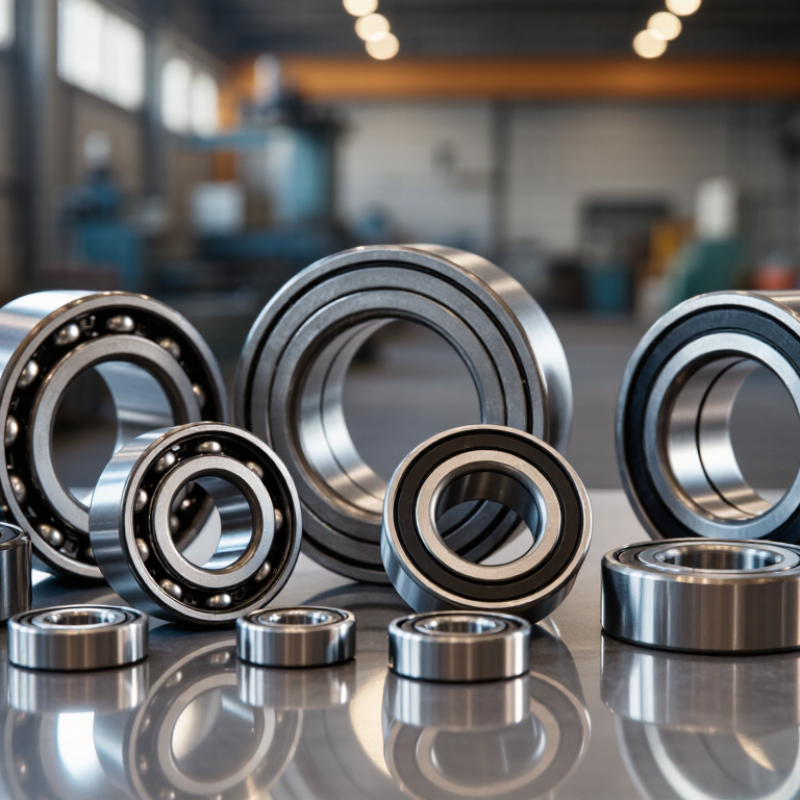
An axle wheel bearing carries vehicle weight while allowing the wheel to rotate with minimal friction. Its basic assembly contains inner and outer rings, rolling elements, a cage, and often seals. The rings form precise tracks; the cage keeps the balls or rollers spaced apart. Seals help retain lubricant and keep water and road grit away. Small details matter.
In a wheel-end assembly, tapered roller bearings handle combined radial and axial loads, while double-row angular-contact ball bearings provide compact support in many modern designs. The right choice depends on load, speed, packaging, and heat management—not just bearing size. Poor sealing can let moisture cloud the grease, while incorrect installation may damage a raceway before the vehicle travels far.
ISO 281:2007 defines the basic rating life, L10, as the life that 90% of a sufficiently large group of identical bearings are expected to reach or exceed under stated conditions. It is a statistical rating, not a promise for every axle. Real service also depends on road shock, alignment, lubricant condition, and fitting quality. A rough road changes the story. Engineers should treat calculated life as a useful reference, then check the actual duty cycle and maintenance evidence.
China Top 10 Axle Wheel Bearing Manufacturers? - Axle Wheel Bearings: Structure, Function, and Main Types
Technical overview of common wheel-bearing components and bearing configurations. The entries are not a manufacturer ranking; actual designs and specifications vary by vehicle and application.
| Category | Component or bearing type | Structure | Primary function and load capability | Typical application or design note |
|---|---|---|---|---|
| Main bearing components | ||||
| Component | Inner ring | Hardened ring with one or more precision-ground raceways; may be integrated with a hub in unitized assemblies. | Provides a running track for the rolling elements and transfers load to the axle or hub interface. | Fit and geometry depend on the bearing arrangement and the vehicle’s mounting design. |
| Component | Outer ring | Hardened ring with raceway surfaces, fitted into or incorporated into the wheel-end assembly. | Provides the opposing raceway and transfers load to the steering knuckle or housing. | In many wheel-end designs, the outer ring is stationary relative to the vehicle structure. |
| Component | Rolling elements | Precision-made balls or rollers positioned between the raceways. | Carry load while enabling relative rotation between the rings. | Element shape and raceway geometry influence load capacity, speed capability, and friction. |
| Component | Cage or separator | Component that spaces and guides the rolling elements; designs and materials vary. | Helps maintain rolling-element spacing and reduces contact between adjacent elements. | May be made from steel, polymer, or other materials selected for operating conditions. |
| Component | Seals and lubricant | Sealing elements protect the bearing interior; grease is commonly retained inside sealed wheel-bearing units. | Help retain lubricant and limit the entry of water and contaminants. | Sealing performance and lubricant selection are important for service life and operating conditions. |
| Common bearing types and wheel-end arrangements | ||||
| Bearing type | Deep-groove ball bearing | Ball elements run in relatively deep, continuous grooves in the inner and outer rings. | Supports radial loads and can also accommodate axial loads in both directions within design limits. | Used in various rotating applications; suitability for a wheel end depends on the required load, stiffness, and packaging. |
| Bearing type | Angular-contact ball bearing | Raceways are arranged so that the contact angle supports combined radial and axial loading. | Carries radial load and axial load; paired arrangements can support axial loads in both directions. | Preload and paired configuration affect rigidity and operating behavior. |
| Bearing type | Tapered-roller bearing | Conical rollers run between matching tapered raceways. | Designed for combined radial and axial loads; axial-load capacity depends on orientation and arrangement. | Opposed pairs are commonly used where the wheel end requires support for axial loads from either direction. |
| Bearing type | Cylindrical-roller bearing | Cylindrical rollers run between cylindrical raceways; internal design determines axial guidance. | Generally well suited to high radial loads; axial-load capability varies by design. | Used where radial-load capacity is important and the arrangement accommodates the required axial movement or guidance. |
| Bearing type | Spherical-roller bearing | Barrel-shaped rollers run on a spherical outer-ring raceway. | Supports substantial radial loads and, depending on design, axial loads while accommodating limited misalignment. | More common in heavy-duty industrial and machinery applications than in passenger-car wheel hubs. |
| Wheel-end arrangement | Unitized hub bearing assembly | Preassembled wheel-end unit that may integrate bearing rows, hub flanges, seals, and, in some designs, a sensor encoder. | Supports the wheel and transfers vehicle loads while reducing the need for separate bearing adjustment during installation. | Configurations vary; features such as mounting flanges and wheel-speed sensing are application-specific. |