


How to Choose the Right Stainless Steel Sheet?
Choosing a stainless steel sheet is less about picking the shiniest surface and more about matching material properties to the job. A kitchen splashback, a food-processing panel, and an outdoor enclosure face different moisture, cleaning, and wear conditions. Small details matter. Grade, thickness, finish, and forming method can affect service life, appearance, and cost. Yet no single grade suits every project.
Start with the environment. Grade 304 is widely used for many indoor and general-purpose applications, while 316 may be considered where exposure to chlorides or harsher conditions is a concern. Confirm suitability with technical data and a qualified supplier; a grade name alone does not guarantee performance. Then check sheet thickness against expected loads, flatness needs, and fabrication methods such as bending or welding. A mirror finish may look striking, but brushed or matte surfaces can hide fingerprints and minor marks more effectively. The best finish depends on use and maintenance.
Before ordering, ask for the material grade, dimensions, finish description, and relevant test or traceability documents. Compare specifications, not just price per sheet. A polished sample can still mislead if the actual sheet differs in finish or thickness. That detail is easy to overlook, and it can mean extra rework. It is worth pausing. This guide explains how to weigh these factors, ask clearer supplier questions, and choose a stainless steel sheet that fits the application without paying for properties you do not need.
Identify the Sheet’s Intended Use and Operating Conditions
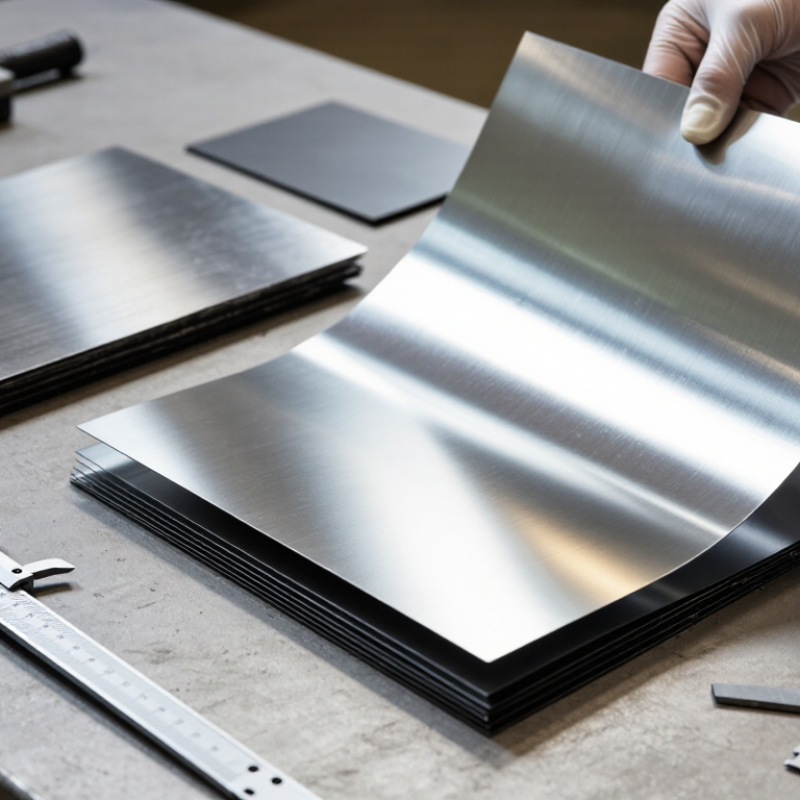
Before choosing a stainless steel sheet, define what it must do. A kitchen splashback needs a cleanable surface, while an outdoor enclosure may face rain, salt, and grit. A machine guard must also handle impact and repeated cleaning. These uses place different demands on the same material. Look beyond the room or product name.
Write down the actual operating conditions. Note contact with acids, chlorides, detergents, or standing moisture, and record temperature changes. A sheet exposed to warm wash water may behave differently from one near a hot process line.
Consider forming, welding, and the finished surface, too; tight bends can reveal cracking that a flat sample hides. It is easy to overlook cleaning chemicals, especially when operators switch products. Ask how often cleaning occurs and whether residues remain.
Then compare suitable grades and thicknesses against supplier data and, for demanding service, test a sample under realistic conditions. A grade name alone cannot predict performance.
Compare Stainless Steel Grades and Their Key Properties
How to Choose the Right Stainless Steel Sheet?
Compare Stainless Steel Grades and Their Key Properties
Grade choice starts with the environment, forming method, and finish—not the word “stainless.” ASTM A240/A240M lists minimum tensile strengths of 515 MPa for grades 304 and 316, and 450 MPa for grade 430. Their listed minimum yield strength is 205 MPa. These figures help compare strength, but they do not predict corrosion life by themselves. Grade 304, with roughly 18% chromium and 8% nickel, suits many indoor and general-purpose uses. Grade 316 adds about 2–3% molybdenum, improving resistance to chloride exposure, such as salt spray near a coast.
Grade 430 is ferritic and magnetic, and often suits dry interiors, appliance panels, or trim. It may be less suitable where salts or harsh cleaners collect. Nickel Institute technical guidance describes molybdenum as a useful alloying addition for improved resistance to localized corrosion. Still, 316 is not a cure-all. Crevices, deposits, and poor cleaning can undermine performance; the right grade depends on actual exposure.
Tips: Match the finish and thickness to the job. For a coastal installation, test a sample near seams and fasteners before ordering a full sheet. Small details matter. ASTM strength values are specification minima, not guarantees of service life.
How to Choose the Right Stainless Steel Sheet? — Compare Stainless Steel Grades and Their Key Properties
| Grade | Family | Typical Composition (wt.%) | Corrosion Resistance | Strength and Formability | Magnetic Response | Weldability | Common Uses | Best Fit When… |
|---|---|---|---|---|---|---|---|---|
| 304 / 304L | Austenitic | 304: 18–20% chromium, 8–10.5% nickel; 304L has carbon limited to 0.03% maximum. | Good general-purpose resistance in many indoor, food-service, and mild outdoor environments. Not suitable for sustained exposure to many chloride-rich conditions. | Good ductility and formability. 304L’s lower carbon reduces the risk of weld-related sensitization. | Usually non-magnetic when annealed; cold working may induce some magnetism. | Good; 304L is often preferred for welded sections where corrosion resistance near the weld is important. | Kitchen equipment, food-processing surfaces, sinks, architectural trim, and general fabrication. | You need a widely available, versatile sheet for general service without unusually severe chloride exposure. |
| 316 / 316L | Austenitic | 316: typically 16–18% chromium, 10–14% nickel, and 2–3% molybdenum; 316L has carbon limited to 0.03% maximum. | Generally better than 304 in chloride-bearing environments, but it is not immune to pitting or crevice corrosion, especially in warm or concentrated chlorides. | Good ductility and formability; strength is comparable to other common annealed austenitic sheet grades. | Usually non-magnetic when annealed; cold working may induce some magnetism. | Good; the low-carbon version is commonly selected for welded applications. | Marine-adjacent equipment, chemical-processing components, pharmaceutical equipment, and food-processing installations. | Improved chloride resistance is needed compared with 304, and the service conditions are still within the grade’s limits. |
| 430 | Ferritic | Typically 16–18% chromium with little or no nickel; carbon is limited to 0.12% maximum in common specifications. | Moderate resistance in mild atmospheric and indoor environments; generally less resistant than 304 or 316 in more aggressive conditions. | Good formability for many sheet applications; cannot be strengthened by heat treatment in the same way as martensitic grades. | Magnetic. | Weldable for suitable designs and procedures, though weld-zone performance and fabrication requirements should be considered. | Appliance panels, interior trim, decorative components, and some kitchen equipment. | You need a magnetic, nickel-lean sheet for mild environments and moderate forming requirements. |
| 410 | Martensitic | Typically 11.5–13.5% chromium; carbon is limited to 0.15% maximum in common specifications. | Moderate resistance in mild environments; less resistant than common 18% chromium austenitic grades in many corrosive services. | Can be hardened by heat treatment to achieve higher strength and hardness; formability and ductility depend on condition. | Magnetic. | Welding requires care, including suitable procedures and possible preheat or post-weld heat treatment depending on section and service requirements. | Wear-resistant components, cutlery, pump parts, and equipment requiring heat-treatable strength. | Hardness or heat-treatable strength is more important than high corrosion resistance or extensive forming. |
| 2205 | Duplex (austenitic-ferritic) | Typically 22–23% chromium, 4.5–6.5% nickel, 3–3.5% molybdenum, and 0.14–0.20% nitrogen. | High resistance to chloride pitting and stress-corrosion cracking compared with 304 and 316 in many applications; actual performance depends on temperature, concentration, and fabrication. | Higher strength than annealed 304 or 316; lower ductility and more demanding forming requirements should be expected. | Magnetic, though magnetic response can vary with product condition and structure. | Weldable with controlled procedures and appropriate filler metal; fabrication should preserve the intended duplex microstructure. | Pressure equipment, chemical-process systems, tanks, and structural components in demanding chloride environments. | You need higher strength and stronger chloride resistance, and the design and fabrication can accommodate duplex stainless steel. |
Selection note: Composition ranges are typical and can vary by specification and product form. Corrosion performance depends on the environment, temperature, surface finish, design, and maintenance. Confirm the applicable material standard and service conditions before specifying a grade.
Choose the Appropriate Thickness, Size, and Surface Finish
Selecting stainless steel sheet starts with the job it must do, not just a catalog label. For a light cover panel, thinner material may reduce weight and simplify cutting. A bracket or work surface may need more thickness to resist bending. The right choice depends on span, support, forming, and expected contact with moisture or chemicals. Small details matter. Ask the supplier to confirm thickness tolerance and available stock sizes before finalizing drawings. That modest check can prevent awkward fit-up later.
Choose sheet dimensions that leave room for cutting and trimming, while avoiding unnecessary offcuts. Compare the usable area with the finished part, not only the nominal sheet size. Surface finish affects appearance and cleaning: a brushed finish can soften visible scratches, while a polished finish reflects more light and shows fingerprints readily. For food-contact or washdown areas, specify the finish and cleaning requirements rather than assuming “smooth” means suitable. Check grain direction on brushed sheets if panels must match. Measure twice. I still find edge allowances easy to overlook, especially around folded corners. A small sample can reveal glare, texture, and handling marks before a larger order.
Check Applicable Standards, Certifications, and Quality Tests
Before comparing prices, identify the standard required for the job and the exact stainless steel grade. Common references include ASTM A240 and EN 10088, but the right specification depends on the project and destination market. Ask the supplier to state the standard, grade, thickness tolerance, and surface finish on the quotation. Details matter.
Request a material test certificate linked to the sheet’s heat or batch number. Check that its reported chemistry and mechanical properties match the specified grade, and confirm that the certificate describes the actual supplied material. A quality management certificate can show that a supplier follows a system, but it does not replace material-specific records. Not always.
Quality checks should match the risks of the application. Review dimensional measurements, surface condition, and test results for tensile strength or hardness where specified. For corrosion-sensitive uses, ask whether an appropriate corrosion test is required; a handheld identification test alone cannot establish every property. Compare documents with the physical sheets, including stamped or tagged batch numbers. If a record is unclear, pause and ask for clarification. I would not treat a neat certificate as proof until its details line up with the order.
Assess Supplier Reliability, Cost, and Material Handling Needs
Choosing stainless steel sheet starts with checking whether a supplier can deliver consistent material, not just an attractive quote. Ask for material test reports, grade details, thickness tolerances, and clear identification on each bundle. Check how the supplier handles shortages or delayed shipments. A quick sample inspection can reveal scratches, uneven edges, or finish variations before a larger order arrives. Small details matter.
Price needs context. Compare the delivered cost, including cutting, packaging, freight, and any processing your shop requires. A cheaper sheet may create more scrap if its dimensions vary or its surface needs extra preparation. It is easy to overvalue the lowest number on a spreadsheet; I would still compare actual usable yield. That estimate is not always exact.
Material handling should fit the sheet’s size, finish, and destination. Thin sheets can flex during lifting, while polished surfaces may show marks from rough contact. Confirm that sheets arrive with suitable separators or protective film, and plan a dry, clean storage area. Check whether your team has the right rack, lifting attachments, and space to move full bundles safely. Sometimes the handling plan is an afterthought. It should not be.
How to Choose the Right Stainless Steel Sheet
Assess supplier reliability, cost, and material handling needs.
Typical density values help estimate sheet weight and plan lifting, transport, and handling. Values are nominal and may vary slightly by product specification. Compare supplier certifications, quality consistency, lead times, and delivered quotes separately, since reliability and price depend on the supplier and order.
Related Posts
-
Top Quality Stainless Steel Sheet Options for Global Buyers?
-
China Top 10 Stainless Steel Sheet Suppliers for Global Buyers?
-
How to Choose the Right Stainless Steel Sheet Metal for Your Project
-

2026 Top Stainless Steel Sheet Metal Applications and Benefits?
-
Top 10 Sheet Metal Types and Their Unique Applications for Your Projects
-

Top 10 Applications of Sheet Metal in Modern Industry?


