7 Tips for Choosing Aluminum Roof Panels
Choosing aluminum roof panels is not just a color decision. It affects heat gain, weather protection, maintenance, and long-term cost. On a sample board, the finish may look silver and uniform; on a sunlit roof, glare, shade, and surrounding buildings change what you see. Small details matter.
The U.S. Department of Energy’s Energy Saver guidance notes that cool roofs can stay more than 50°F cooler than conventional roofs under sunny conditions. That figure describes roof-surface temperature, not guaranteed indoor savings. Actual results depend on climate, insulation, ventilation, roof color, and coating performance. In 2023, NOAA’s National Centers for Environmental Information recorded 28 U.S. weather and climate disasters with losses exceeding $1 billion each. Those figures do not prove one roofing material will prevent damage. They do show why panel profiles, attachment methods, and local exposure deserve careful review.
The seven tips ahead examine those choices, from panel thickness and finish to installation details and warranty language. Look for manufacturer specifications, tested performance data, and advice from qualified local roofers. Ask how the system handles coastal salt, hail, or strong winds where relevant. Not every product suits every building. And a premium label alone proves little. Aluminum can resist corrosion, but performance still depends on alloy, coating, detailing, and workmanship. Compare the whole roof system, not just the panel sample.
Identify Your Roof’s Design, Slope, and Load Requirements
Before choosing aluminum roof panels, identify the roof shape and measure its slope. A low-slope roof may need a different panel profile and seam detail than a steep gable. NRCA guidance generally classifies roofs at 3:12 or less as low-slope; panel manufacturers may set different minimums. Check the panel’s tested installation requirements, not just its appearance. Small details matter. Note valleys, dormers, and roof transitions, where water can linger or snow can drift. A quick visual check is imperfect; confirm dimensions on site.
Next, establish the loads the roof must carry and resist. These include panel weight, existing layers, snow, wind uplift, and, where relevant, drifting snow. ASCE/SEI 7-22 provides location-based hazard data used in structural design, including wind and snow criteria. NOAA recorded 28 U.S. weather and climate disasters costing at least $1 billion each in 2023; that national figure is context, not a local design value. Do not guess. Have a qualified building professional verify local design loads, roof framing capacity, and fastener spacing before ordering panels. An older deck may look sound yet conceal weak connections, so document what remains uncertain.
7 Tips for Choosing Aluminum Roof Panels
Identify Your Roof’s Design, Slope, and Load Requirements
Roof pitch is shown as vertical rise per 12 inches of horizontal run; the bars show the equivalent slope angle. These angles are geometric conversions, not panel suitability ratings. Check the selected panel system’s minimum slope and confirm that the roof structure meets local dead-load, wind, and snow-load requirements.
Compare Aluminum Panel Profiles and Joining Systems
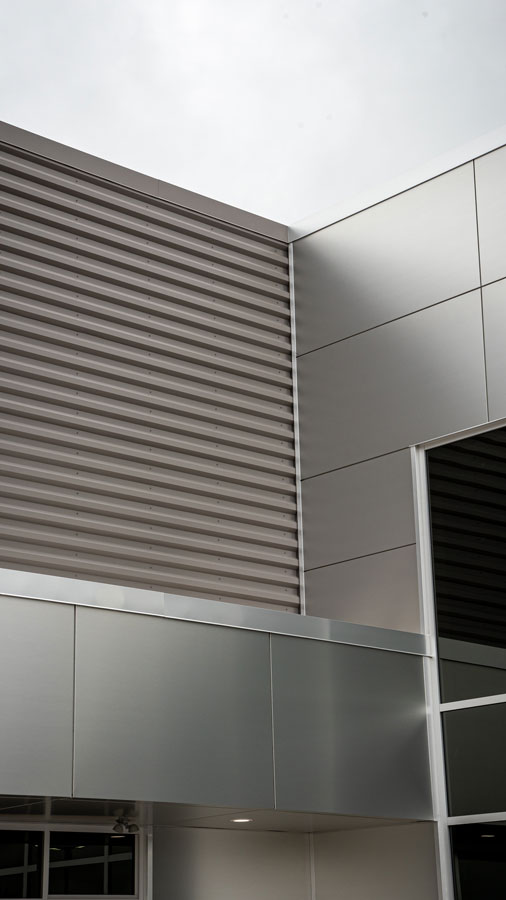
Aluminum roof panels differ in both shape and the way their edges connect. Standing-seam profiles have raised ribs that help guide rain toward the eaves. Corrugated panels use repeating waves, while ribbed panels have broader, flatter sections between raised lines. Those shapes affect stiffness, appearance, and how water moves across the roof. A deeper profile may suit a wide, exposed roof, but it can look oversized on a small porch. Not always.
The joining system matters just as much. Exposed-fastener panels overlap at the edges and use screws with sealing washers. They are straightforward to inspect, but each fastener needs careful placement and tightening. Concealed-clip systems hide the fasteners beneath raised seams, leaving a cleaner surface and allowing some movement as the metal warms and cools. Mechanical seams are folded together with tools; the finished joint depends on the specified panel and installation method. A neat seam is not proof of a sound roof.
Compare the required roof pitch, panel coverage, and approved fastening details before choosing a profile. Then check how valleys, eaves, and roof penetrations will be flashed. These small transitions often demand more attention than the broad, open roof area. Ask for a sample panel and examine its edge connection, not just its color. I would not assume two profiles can share the same clips or seam tools. Verify compatibility in the product’s installation instructions, and have the roof design checked for local wind and snow conditions.
Select the Right Panel Thickness, Finish, and Coating
Aluminum roof panels should be selected by measured thickness, not gauge labels alone, since gauge conventions can vary. Ask for the metal thickness in millimeters and confirm the alloy, panel profile, and support spacing. These details affect stiffness and resistance to denting. A thicker sheet is not automatically the better choice; wind exposure and roof framing matter too. Have the panel system checked against local design loads.
Finish and coating influence heat, fading, and corrosion resistance. The U.S. Department of Energy’s Guidelines for Selecting Cool Roofs reports that reflective roofs can be up to about 50°F cooler at the surface than conventional roofs under comparable conditions. That figure is not a guaranteed energy saving. Roof pitch, shade, insulation, and climate all change performance. Check published solar reflectance and thermal emittance values, rather than relying on color names.
For coastal air or frequent wetting, ask for coating test data and edge-protection details. Inspect cut edges and fasteners; small scratches can become weak points. Not always obvious. I would also compare warranty terms with the expected exposure, while remembering that a warranty does not prove real-world durability. A matte finish may hide glare, but it can show dirt differently. Request a sample and view it in direct sun before deciding.
Match Panel Performance to Your Local Climate
Aluminum roof panels should match the weather your roof actually faces, not a generic “all-weather” label. NOAA’s 1991–2020 U.S. Climate Normals provide a useful baseline for local temperature, rainfall, and snowfall. Then consider site-specific wind exposure. A regional average cannot describe every roof.
In hot, sunny climates, look for documented solar reflectance and thermal emittance ratings. The U.S. Department of Energy reports that cool roofs can stay up to 50°F cooler than conventional roofs under sunny conditions. This may reduce heat entering the attic, but actual results depend on insulation, ventilation, roof angle, and shade. A bright finish alone does not guarantee strong performance.
Coastal air, heavy rain, snow, and freeze-thaw cycles change the details. Ask for coating and fastener specifications suited to salt exposure, and check seams, drainage, and attachment capacity against local design loads. In snowy regions, smooth panels may release snow suddenly above doors or paths. Small detail, big consequence. Inspect cut edges and penetrations, too; they are easy to overlook, and can leave protective coatings vulnerable. Climate matching is not exact at a single address, so have a qualified roofer assess the whole assembly, not just the panel.
Compare Installation Needs, Total Cost, and Warranty Coverage
Tip: Compare installation needs before comparing panel prices. Aluminum’s low weight may simplify handling, but roof geometry still drives labor. Ask whether each quote includes tear-off, underlayment, clips, flashing, and disposal. Standing seams, valleys, skylights, and uneven decking can require careful fitting. Get contractors to price the same scope.
Tip: Compare total cost over the roof’s expected service life, not just the invoice. The 2024 Cost vs. Value report lists a U.S. metal-roof replacement average of $49,928, with $24,034 in reported resale value. This is a broad benchmark, not an aluminum-panel quote; region, roof size, and tear-off conditions affect costs. Request itemized labor, materials, fasteners, edge metal, and ventilation. Small omissions matter. The benchmark has limits.
Tip: Read warranty terms beside the estimate. Separate panel finish coverage from material-defect and installation-workmanship coverage; they may have different terms and exclusions. Check whether salt air, standing water, cut edges, or contact with other metals affect coverage. Ask who handles leak claims and whether labor is included. Keep invoices and installation records. A long warranty sounds reassuring, but its exclusions deserve equal attention.